Choosing between the GRE and GMAT isn’t about which test is easier it’s about which one fits your goals, strengths, and target programs. This guide breaks down the real differences, acceptance trends, and strategic factors to help you make a smarter, ROI-driven decision for your study abroad journey.
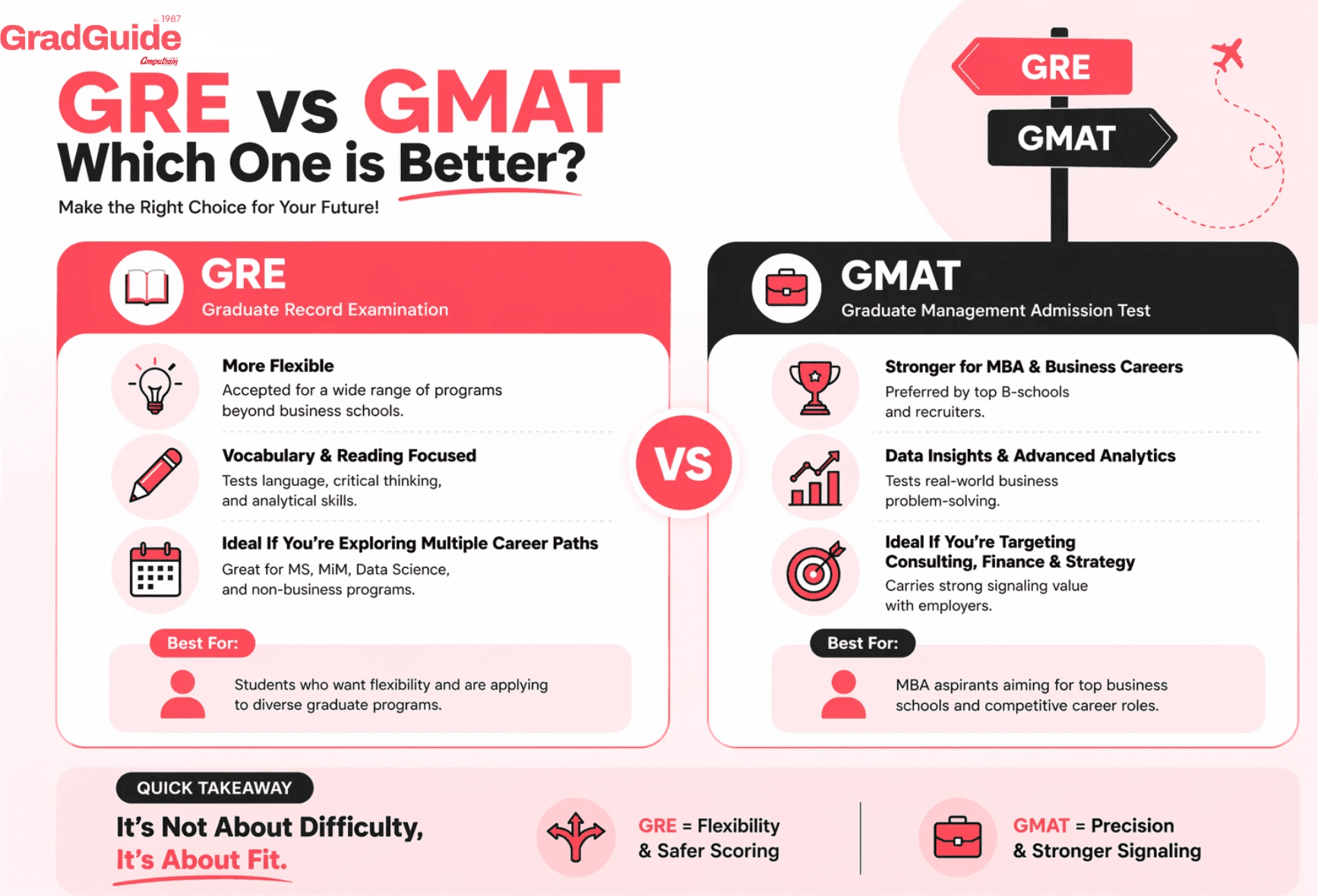
GRE vs GMAT: Which Test Should You Actually Take?
A proper breakdown for students who want to spend their prep time wisely:
If you've started researching master's or MBA programmes abroad, you've almost certainly hit this question: GRE or GMAT?
The internet will tell you to "take the one your target schools prefer." Not wrong, but not very useful either. Here's what that actually means in practice and how to figure out the right call for your profile.
First: Which test suits your goal?
For most MBA applicants, it used to be a GMAT-or-nothing situation. That's changed significantly. As of 2024-2025, over 95% of MBA programmes globally accept both the GRE and GMAT. If a school you're targeting still requires GMAT specifically, that's worth noting but it's increasingly rare.
For MS programmes in STEM, business analytics, finance, or public policy, GRE is typically the default.
Targeting an MBA? Either test works, but GMAT still carries a slight historical weight at some top-10 programmes.
Targeting an MS/MiM/MPA? GRE is almost always your test.
What's actually different between them?
Both tests assess quantitative and verbal reasoning. But they’re still a little different:
GMAT Focus
Three sections: Quantitative Reasoning, Verbal Reasoning, Data Insights
Emphasis on data interpretation, logical reasoning, and business-relevant problem-solving
Shorter format: approximately 2 hours 15 minutes
Score range: 205-805
Adaptive at the section level
GRE General Test
Three sections: Verbal Reasoning, Quantitative Reasoning, Analytical Writing
Broader vocabulary emphasis in the Verbal section
Includes an essay component (Analytical Writing Assessment)
Score range: 130-170 per section
Adaptive at the question level within sections
More widely accepted across disciplines
Which test plays to your strengths?
Lean towards GRE if:
You're a strong verbal/writing candidate, the GRE's AWA (essay section) and vocabulary-heavy verbal section can let you demonstrate range
You're applying to multiple disciplines (MS + MBA), since GRE covers more courses
Your quant skills are solid but not exceptional, GRE's quant is generally considered slightly less intense than GMAT's Data Insights section
You want flexibility: GRE scores are accepted for law school, some medical programmes, and graduate fellowships too, so if you aren’t sure about which course to apply for and would like some flexibility regarding that then the GRE is for you.
Lean towards GMAT if:
You're specifically targeting traditional top-10 global MBA programmes where GMAT is the cultural norm (Like: Wharton, HBS, LBS, INSEAD): If your goal is consulting, finance, or strategy, GMAT gives stronger signaling and aligns better with what both schools and recruiters expect.
You're genuinely strong at logical reasoning and data interpretation under pressure
You don't want to write essays as part of the exam itself
Your verbal English is functional but not your strongest suit GMAT's verbal section is less vocabulary-dependent
The ROI question (which is there on everybody’s mind)
Test prep costs money and time. So it becomes really important to “invest” your time, money and energy into the right one and what the return usually looks like:
Parameters | GRE | GMAT Focus |
Exam fee (USD) | ₹22,000 – ₹23,500 (General Test, including taxes) | ₹24,500 – ₹30,000+ Test centre: ₹24,700–₹25,900 Online: ₹27,000–₹33,000 (with taxes) |
Typical prep time | 2-4 months | 2-4 months |
Retake policy | Up to 5 times per year | Up to 5 times per year |
Score validity | 5 years | 5 years |
Free practice tests | 2 (ETS) | 2 (GMAC) |
Note: if you're applying to 6+ programmes across MBA and MS tracks, a single GRE score gives you more flexibility.
What top colleges actually say:
Most admissions offices will tell you the test itself matters less than your score relative to the programme's median. A 730 on the GMAT and a strong GRE equivalent (roughly 163Q + 160V) are both competitive at the same school. What matters is where your score lands against their reported range, not which test you chose.
Look up the median GMAT/GRE scores for every programme on your shortlist. That's your real benchmark.
A few scenarios that we have seen with students:
"I want an MBA at a top European school (LBS, INSEAD, IE)." GMAT is the historical norm. Both are accepted, but if you're a borderline candidate, going with GMAT signals you've engaged with the MBA-standard exam. It's a small signal, but it exists.
"I want an MS in Business Analytics or Finance." GRE, almost certainly. GMAT acceptance is inconsistent across MS programmes, and your quant score matters more than which test you used.
"I want to apply to both MBA and MS programmes in the same cycle." Take the GRE. One test, maximum coverage.”
"My quant background is weak and I need to demonstrate improvement." GRE's quant section has a lower ceiling of difficulty for most question types. If you're rebuilding fundamentals, GRE gives you a slightly more achievable quant target.”
The bottom line
There's no universally "better" test. There's the test that's better for your programme list, your strengths, and your timeline.
Before you register for either:
List your target programmes and check their median score ranges
Take one free official practice test for each (ETS PowerPrep for GRE, GMAC Official Starter Kit for GMAT)
Compare your natural performance and then map out the gap to close.
If you want a second opinion on where your profile stands and which test makes more sense for your shortlist, that's exactly what we're here for. You can get in touch with us and we can take it from there.
Disclaimer: Test acceptance policies and median scores change each admissions cycle. Always verify directly with the admissions office of each programme on your list before registering.
Talk to a GradGuide expert about your study-abroad plans.